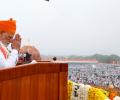
Prime Minister Narendra Modi addressed the nation on Independence Day, focusing on economic growth, self-reliance, and national security. He emphasized manufacturing quality products at affordable prices, supporting farmers, and combating terrorism and infiltration.
In the wake of the recent hostilities, both sides have moved from weapons to words, with India dispatching several delegations to visit more than 30 capitals across the world. A similar effort by Pakistan is set to start on Jun 2.

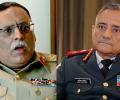
Top military officials from India and Pakistan highlighted their views at the Shangri-La Dialogue in Singapore, billed as Asia's premier defence forum, amid heightened tensions between the two sides following last month's military confrontation.

SAAW, an indigenously designed and developed 120 kg class smart weapon, has been developed by the Defence Research and Development Organisation.

Nearly all of the nine nuclear-armed States, including India and Pakistan, continued intensive nuclear modernisation programmes in 2024, upgrading existing weapons and adding newer versions, according to a report by a global think-tank.

Congress leader Rahul Gandhi on Wednesday claimed that a 'systematic vote chori' method, evolved by Prime Minister Narendra Modi and the Election Commission to 'kill Indian democracy', will be deployed in the Bihar assembly polls as well.

Air Chief Marshal A P Singh emphasizes the importance of clear objectives and timely conflict termination, citing Operation Sindoor as an example for the world to follow.

A Thane court acquitted 17 individuals accused of rioting in 2015, citing insufficient evidence, failure of identification, and investigative lapses. The prosecution's case relied heavily on police testimonies and video recordings deemed inadmissible.
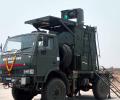
'DRDO is working on a number of technologies that will give India Star Wars capability.'

The United States State Department has authorised a Foreign Military Sales (FMS) case for Turkiye to purchase AIM-120C-8 Advanced Medium-Range Air-to-Air Missiles and related elements of logistics and program support for an estimated cost of $22 million.

Announcing the launch of "Mission Sudarshan Chakra", Modi said it will be aimed at neutralising enemy threat and enhancing India's offensive capabilities.
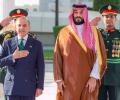
'Saudi-Pak defence pact is to anchor the defence and security of Saudi Arabia and not Pakistan, per se, with Islamabad being the junior partner.'

Even Prime Minister Narendra Modi told US Vice President JD Vance on May 9 that Indian response will be "more forceful, stronger, devastating" in response to Pakistani actions, the sources said.
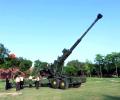
The Indian government outlines its futuristic defence programme, Sudarshan Chakra Mission, focusing on indigenous development, predictive technologies, and targeted counter-action systems to enhance national security.

'An important consideration was that we should always be at the top of the escalation ladder. When we reach a military objective, we should try and put a stop to it'
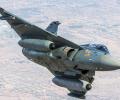
HAL's order book amounts to Rs 2.45 trillion by end of Q2FY26, implying a book-to-bill ratio of 32 times based on FY25 revenue.

The system, featuring three centre backs and aggressive wing backs, marked a significant departure from the traditional 4-3-3 formation and appeared to address Real's defensive frailties from a disappointing, trophyless 2024-25 campaign.

Chief of Defence Staff Gen Anil Chauhan identifies China border dispute as India's biggest national security challenge, followed by Pakistan's proxy war. He also highlighted regional instability, future warfare scenarios, and dealing with nuclear-armed adversaries as major concerns.

Twenty-six foreign leaders, including Vladimir Putin and Kim Jong Un, will attend China's V-Day commemorations on September 3. Japan has expressed concerns about the event's anti-Japanese overtones.
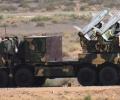
India's indigenously developed 'Akashteer' air defense system performed exceedingly well during 'Operation Sindoor,' according to Defence Research and Development Organisation (DRDO) chief Samir V Kamat. The fully automated system, deployed against terror sites in Pakistan and Pakistan-occupied Kashmir, integrates various radar systems, sensors, and communication technologies. Kamat expressed confidence in the system's success drawing international interest, highlighting India's progress toward self-reliance in the defense sector. He also addressed the future of warfare, emphasizing the need for a blend of traditional and emerging technologies, and outlined the development timeline for the indigenous 5.5-generation stealth fighter aircraft, the Advanced Medium Combat Aircraft (AMCA).
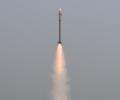
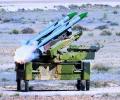
The MRSAM is an advanced path-breaking air and missile defence system that provides ultimate protection against a variety of aerial platforms. Defence experts say that it can shoot down enemy aircraft at a range of 50-70 km.
The attacks against the Pakistani air force have taken them at least five years back and caused great damage to them and their Chinese and Turkish inventory of weapons.

The MiG-21's sharp silhouette and supersonic roar will live on in the memories of those who flew it, those who maintained it, and those who watched it streak across the sky as a symbol of India's strength, asserts IAF veteran Air Commodore Nitin Sathe (retd).

The use of drones to mount attacks was new to the ethnic clashes in Manipur that left over 200 people dead since May last year.
'When one air force (India's) hits the other's airbases with impunity and that air force (Pakistan's) is not able to respond, then the air force, which has put the other's airbases out of commission, has won.'

Low-level lightweight radars; very short-range air defence systems (launchers and missiles); remotely piloted aerial vehicles; loitering munitions, including vertical take-off and landing systems; different kinds of drones; bullet-proof vests; ballistic helmets; quick-reaction fighting vehicles -- heavy and medium; and night sights for rifles (aiming devices that are visible in low light).
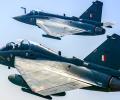
HAL aims to raise output from the current ceiling of 24 aircraft a year to 30 by the end of 2027

The Enhanced Pinaka has demonstrated a range of 75 km and an ability to strike within 10 metres of where it is aimed. This allows a Pinaka battery to destroy a terrorist camp, or an enemy post, logistics dump or headquarters, without sending soldiers across the border.

The system performance was also validated through the data captured by a number of radars, telemetry and electro-optical tracking system deployed by ITR, Chandipur.
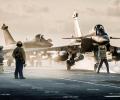
India is expected to finalize the procurement of 26 naval variant Rafale jets and three Scorpene submarines from France in the coming weeks, further bolstering its naval capabilities. The deals, which are in the final stages of approval, could be announced during Prime Minister Narendra Modi's visit to Paris next month for an AI summit. The procurement of the Rafale (M) jets will be based on an inter-governmental agreement (IGA). The Indian Air Force is considering acquiring additional Rafale fighter aircraft squadrons. The deal for three Scorpene submarines follows the successful construction of six Scorpene submarines in India under Project 75. The defense and strategic partnerships between India and France have been strengthening in recent years, with both countries collaborating on joint development projects for jet and helicopter engines and advanced defense technologies.

Pakistan has banned Indian-flagged ships from entering its ports with immediate effect after India imposed fresh punitive measures, including a ban on the import of goods and entry of Pakistani vessels into its ports, against Islamabad amid heightened tensions following the Pahalgam terror attack. The move comes after India announced a raft of punitive measures against Pakistan, including the suspension of the Indus Waters Treaty, shutting down of the only operational land border crossing at Attari, and downgrading of diplomatic ties following the terror attack. The Pakistan Army has also conducted a successful training launch of the Abdali Weapon System, a surface-to-surface missile with a range of 450 km, saying it was aimed at ensuring the operational readiness of troops and validating key technical parameters. India considers the test launch of the ballistic missile a "blatant" act of "provocation."

Polish Prime Minister Donald Tusk confirmed that the country's airspace had been violated by "a huge number of Russian drones" which were shot down by its military.
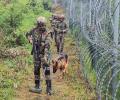
The Indian Army has enhanced security along the Line of Control (LoC) in Jammu and Kashmir's Rajouri district by deploying state-of-the-art equipment, including smart fence systems, robotic mules, and all-terrain vehicles. These upgrades aim to counter infiltration and ensure peaceful Independence Day celebrations.

The Border Security Force (BSF) launched "Operation Sindoor" in retaliation to unprovoked firing and shelling by Pakistani Rangers along the International Border (IB) in Jammu. BSF troops destroyed three terrorist launch pads and targeted 76 Pakistani border outposts and 42 forward defence locations. The BSF action came after Pakistan launched heavy firing and shelling on 60 Indian posts and 49 forward positions, reportedly providing cover for an attempted infiltration by 40-50 terrorists.

The missile showcased its precision and capability to neutralise targets, the statement said.
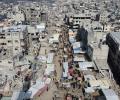
'The world does not know that the families of these journalists were threatened and one by one they too have been killed.'

'The background for the Saudi-Pakistan agreement is the fact that the regional security order has collapsed due to the Israeli attack on Doha.' 'The Americans have largely abandoned their security guarantee for West Asia and the region has no choice but to look at alternatives.'
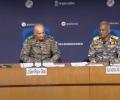
India's robust air defence system effectively thwarted Pakistani attempts to target Indian installations.
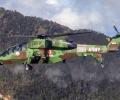
The CCS approved the proposal to buy 156 LCH 'Prachand' worth over Rs 62,500 crore from HAL, Defence Minister Rajnath Singh said.
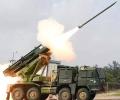
'A crucial role in bolstering the Indian Army's firepower by enabling precise and long-range strikes.'
